It turns out that somewhere between leaving the house and reaching my destination, the fantasy died. Because no linen dress, expensive deodorant, or positive attitude stands a chance against a London heatwave.
At 10:30 AM on the Bakerloo Line, somewhere between Marylebone and Baker Street—which is barely a commute, really, yet somehow long enough to induce existential dread—I found myself staring at a woman’s back. Not out of rudeness, but out of a desperate, anthropological curiosity. She was wearing a butter yellow linen-blend jacket, unbuttoned over a ribbed silk camisole, and she looked, against all thermodynamic logic, composed. Her hair wasn’t plastered to her temples. Her collar was dry. She was reading a paperback without the pages wilting in her grip.
I, meanwhile, was wearing an earthy brown shift dress. A sensible, practical choice I’d smugly convinced myself would be forgiving on a sweltering commute. It was a mistake I realised within the first thirty seconds of the journey. Almost immediately, I was conducting a silent, private inventory of every place the human body can possibly secrete moisture, and the earthy brown, dependable as I’d imagined it to be, was documenting every single one. By the time we pulled into Baker Street—the first stop on my six-stop hop to Embankment—I had the distinct, humbling realisation: I had dressed for competence, and the weather had dressed for a coup in Marrakech.
Now, I know what you’re thinking: Marylebone to Embankment? That’s barely a Tube journey. You get on, you blink, you’re there. What’s there to panic about? And you’d be right.
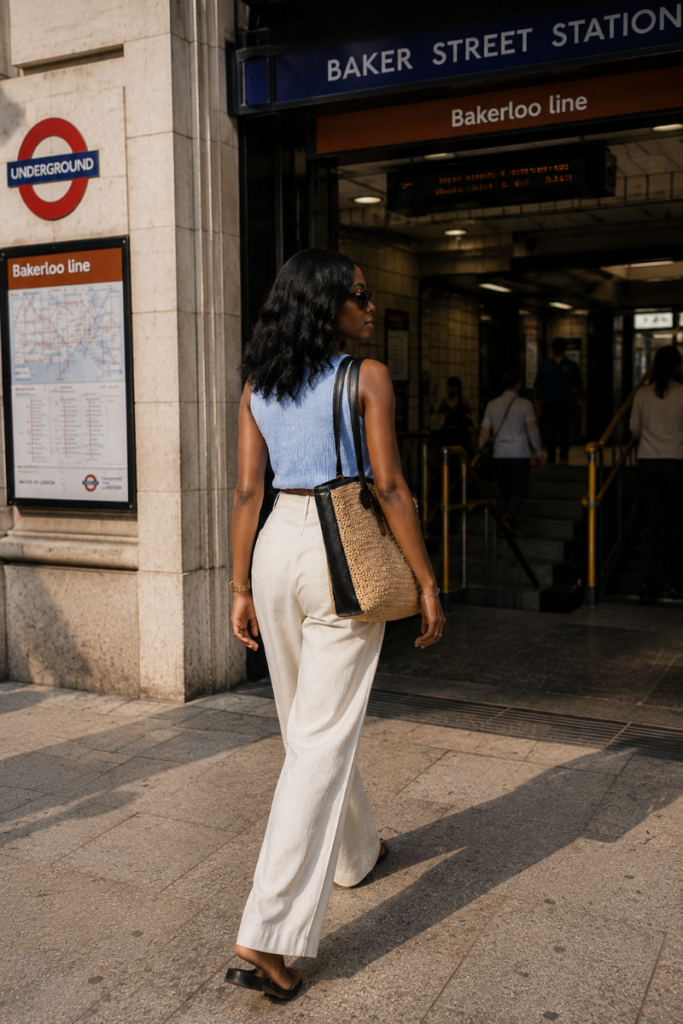
On paper, it’s almost laughably short. My commute is so brief I can practically taste the Embankment air before I’ve even properly found a seat. But here’s the thing about the Bakerloo Line: it does not care about the brevity of your journey. It does not care that you’re only on for six stops. It will punish you anyway. The stretch between Marylebone and Baker Street alone is enough to turn your collar translucent. By the time you’ve endured the slow, lurching crawl through Regent’s Park to Oxford Circus—a stretch of tunnel so notoriously unventilated that it feels like the train is purposely stalling to punish you for not taking the Circle line—you have already lost the battle.
Then comes Piccadilly Circus. Here’s where the doors open and a wall of stale, tourist-scented air hits you like a physical blow, and you watch a dozen people with enormous suitcases and no spatial awareness board the carriage, compressing the existing heat into something almost solid. By Charing Cross, you’re not a professional; you’re a cautionary tale. You emerge at Embankment gasping. Your dignity in tatters, wondering how six stops could possibly feel like a trek across the Sahara.
And that’s when it occurred to me:
No outfit has ever been designed with tunnel air in mind.
For years, we’ve been seduced by the corporate lie of the synthetic—the polyester crepes and stretch-viscoses that promise to hold their shape but end up entombing us by the third stop. Devoid of airflow, they betray us with the quiet treachery of a malfunctioning air-conditioning unit.
Meanwhile, the real heroes of a relentless summer are embarrassingly simple: linen, silk, and crisp cotton poplin. We’ve historically punished linen for its stubborn refusal to stay crisp, but in July, a wrinkle isn’t a faux pas—it’s a philosophy. It’s evidence that you exist in three dimensions, and that you braved the Underground to prove it.
Fabric, though, is only half the story. Colour, as it turns out, is a matter of physics dressed up as aesthetics. To wear black to work in the heat is an act of profound masochism. Yet we all do it because it’s the ultimate shorthand for having your life together. But there are alternatives. The palette of survival is the palette of an English watercolour: ivory, dove grey, chambray blue, oatmeal, butter yellow and soft earth tones. They don’t eliminate the heat, but they refuse to amplify it.
Read More: Every Stylish Summer Outfit You’ll Want On Rotation in the July August Heat
And once you’ve made peace with fabric and colour, architecture becomes the final piece of the puzzle. The woman in butter yellow seemed to understand this instinctively. The secret wasn’t simply the shade she was wearing—it was the silhouette she chose to project.
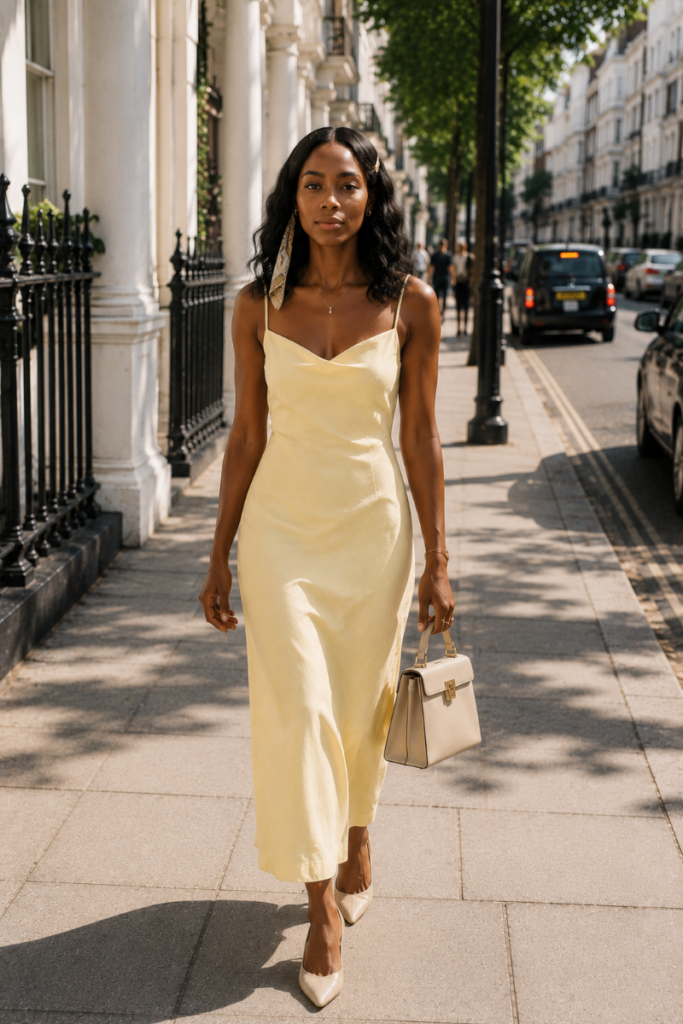
She mastered the ultimate summer subterfuge: maximum airflow disguised as maximum effort. It’s the logic of a breezy A-line that refuses to cling to your thighs like a needy ex. Or a tailored short paired with a lightweight blazer you’re practically obliged to remove the moment you reach the platform and gasp your first lungful of surface-level air.
By the time we finally reached Embankment, the woman in butter yellow folded her paperback, slipped on a pair of sunglasses and merged into the lunchtime crowd. I lost sight of her almost instantly, which felt slightly unfair given how much mental analysis I’d already dedicated to her outfit.
What stayed with me—what I couldn’t stop thinking about, actually—was how untouched she looked by the journey we had just shared. She had travelled through the same overheated carriage, endured the same stale, recycled air, and lurched through the same slow drag through tunnels that feel designed to test your patience and your patience alone. Yet she arrived looking composed, like the Tube had simply agreed to behave for her specifically.
Meanwhile, I caught my reflection in the station window. My earthy brown dress, the colour I had chosen because I thought practicality might somehow outsmart the weather, now looked less like a clever decision and more like an experiment that hadn’t quite held up in real conditions.
For a moment, I found myself wondering if she had simply chosen better linen. Something lighter. Something that behaved differently in heat. A small detail that made all the difference.
But the longer I stood there, the less convincing that explanation felt. It wasn’t really about one dress versus another. It was about what we expect clothes to do for us when conditions shift. We want them to stay composed, to hold shape, to remain untouched, even when nothing around us is.
Perhaps style isn’t really about finding colours that never reveal the heat. Perhaps it’s about choosing clothes that can sit with it instead. Clothes that wrinkle because you’ve moved through a day, soften because you’ve actually worn them, and allow you to arrive somewhere looking like yourself rather than a carefully managed version of yourself.
All morning I had assumed the lesson was simple: I should have worn butter yellow instead of earthy brown. A better colour choice. A smarter decision. Something more in tune with the weather.
But somewhere between Marylebone and Embankment, that certainty began to loosen.
Summer is not asking me to disappear into safer colours. It IS asking me to stop expecting perfection from any of them.
Which left me wondering… perhaps the question was never what to wear in this heat, but what we expect our clothes to do once we put them on?