


From sunlit afternoons in Rome to vineyard visits and leisurely dinners, five ways to approach Italian autumn dressing with familiar wardrobe pieces, thoughtful proportions and a little imagination.
Few destinations make getting dressed quite as enjoyable as Italy. Perhaps it is the architecture, the unhurried pleasure of an afternoon aperitivo, or simply the way ordinary clothes acquire a different presence against an aged stone backdrop. A crisp shirt and jeans feel remarkably elegant on a Roman street, while a trench coat and loafers seem perfectly at home among the vines. Yet the appeal of Italian dressing lies as much in its apparent effortlessness as in the small details that make an outfit work.
Planning what to wear in Italy in autumn, particularly in October, requires a little more realism than glossy travel photographs suggest. My husband and I spent ten days travelling through Rome, Tuscany, Brescia and Le Marche, discovering just how differently autumn can present itself across the country. There were afternoons warm enough for sleeveless tops, rainy days that called for proper outerwear and cooler mornings when a cardigan made all the difference.
Our itinerary took us to Pitigliano, the extraordinary Tuscan hilltop town built into volcanic rock, and to Avignonesi for a wine tour near Montepulciano. We also spent time in the countryside of Le Marche, staying at Officina del Sole, surrounded by vineyards and olive groves. Each destination presented its own wardrobe considerations, which made the versatility of the clothes I’d brought particularly satisfying.
What interested me most was how easily familiar pieces adapted to different surroundings. A change of shoes could make casual separates suitable for dinner, while a structured blazer or long cardigan could alter the silhouette without requiring an entirely new outfit. The possibilities came less from packing extensively than from understanding how individual pieces worked together.
Whether you’re planning a Roman city break, a wine-tasting holiday in Tuscany or a journey across several Italian regions, these five autumn Italy outfit formulas offer a starting point for dressing with practicality, individuality and a little more imagination.
1. The Roman City Look: White Denim and Sculptural Accents
The formula: White cropped jeans + black sleeveless top + sculptural belt + cognac handbag + comfortable flats
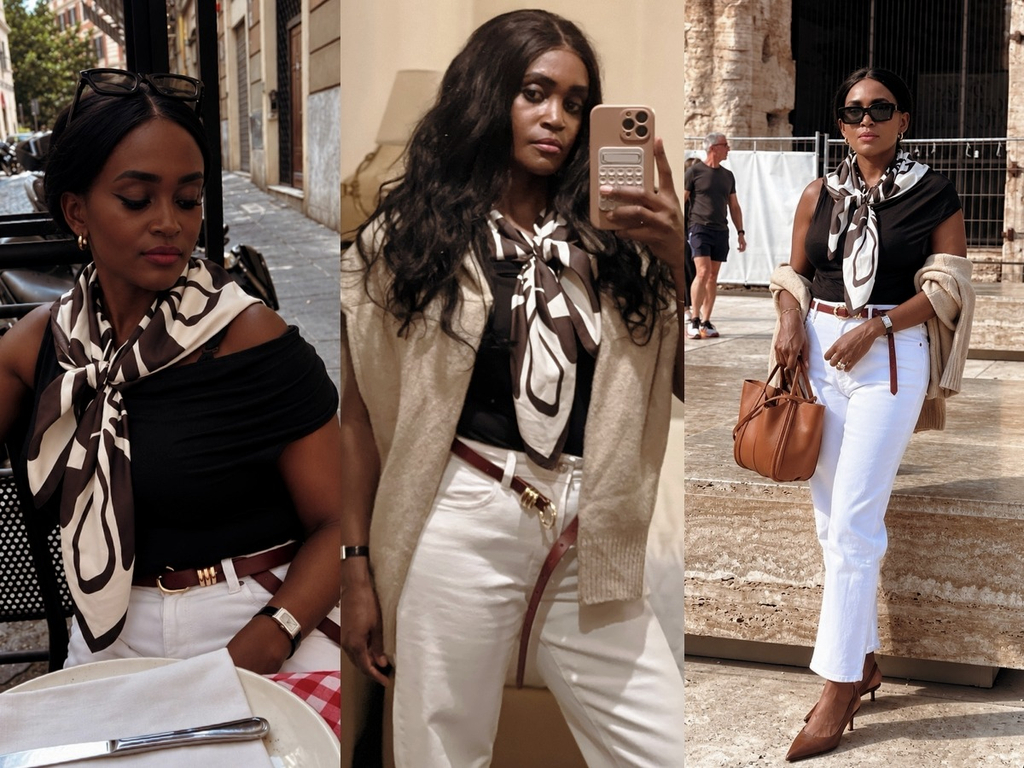
There is an easy confidence in an outfit that refuses to overcomplicate itself. Black and white remains a classic combination for good reason, but its real advantage lies in the freedom it offers to experiment with proportions, texture and accessories without overwhelming the simplicity of the clothes.
For a warm October afternoon in central Rome, I wore high-waisted white cropped jeans with a black sleeveless top, introducing a burgundy-brown belt with a sculptural gold buckle and a cognac handbag. A black-and-cream scarf, angular sunglasses and gold jewellery added further definition, giving an otherwise straightforward combination a more individual finish.
The cropped hem was particularly useful because it exposed the ankle, allowing the shoes to remain visible rather than disappearing beneath the denim. Meanwhile, the belt defined the waist and introduced a focal point, demonstrating how a well-chosen accessory can change an outfit’s proportions without adding another garment.
Rome also offered a reminder that the calendar isn’t always a reliable guide to getting dressed. While October might suggest knitwear and autumn coats, the afternoons we experienced in the city were warm enough to make heavier layers unnecessary. A breathable top and comfortable flats were far more appropriate for walking through the historic centre than the elaborate layering I’d imagined before leaving London.
For anyone wondering what to wear in Rome in October, I would begin with the forecast rather than the season’s usual wardrobe expectations. Lightweight separates, an optional layer and shoes suitable for long walks offer considerably more flexibility than dressing for autumn in the abstract.
The styling takeaway: When working with a minimal colour palette, concentrate on proportion and structural accessories. A sculptural belt or distinctive handbag can give familiar basics a completely different finish without adding unnecessary warmth.
Read More: How I’m Styling a Cropped Trench Coat This Spring (And Why It’s Changing the Way My Clothes Sit)
2. The Vineyard Look: Olive Outerwear and Relaxed Tailoring
The formula: Army-green trench coat + denim or white shirt + straight-leg jeans + burgundy knit + loafers or ballet flats
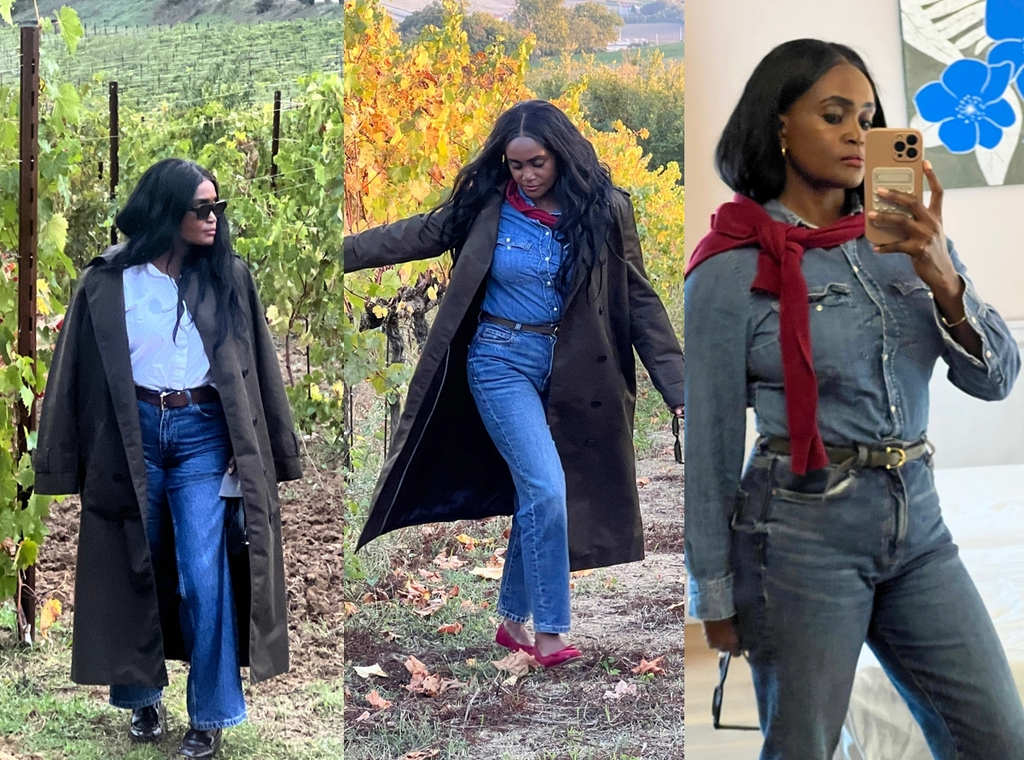
The romantic image of an Italian vineyard usually involves beautifully dressed visitors sipping wine against a backdrop of rolling hills. The practical reality is that a wine estate is also a working agricultural environment, where gravel paths, cellar visits and changing weather can complicate even the most carefully planned outfit.
For our wine tour at Avignonesi near Montepulciano, I built my look around familiar wardrobe pieces, beginning with blue jeans and an army-green trench coat. In one variation, I wore a crisp white shirt tucked into my jeans, secured with a brown leather belt and finished with coffee-brown loafers. The combination was simple, but the contrast between white cotton, blue denim and muted green outerwear gave it definition without relying on elaborate accessories.
I also experimented with double denim, pairing a blue denim shirt with jeans in a similar wash. Double denim can sometimes feel overly coordinated, particularly when both pieces are close in colour, but the trench provided a useful contrast, breaking up the blue and introducing a more structured silhouette.
A burgundy knit draped around my shoulders added another dimension to the outfit. Beyond providing an extra layer when needed, its rich colour worked particularly well against the blue denim and army-green trench. The effect became even more noticeable when I changed into burgundy ballet flats, introducing a coordinated accent without making the combination feel overly matched.
What I particularly appreciate about this approach is how the same core pieces can accommodate different styling choices. The white shirt creates a sharper, slightly more traditional look, while double denim feels relaxed and contemporary. The trench brings structure to both, making it useful for a countryside setting where the weather and terrain can change throughout the day.
There was also something particularly appealing about wearing these earthy tones among the vineyards in autumn. The muted green of the trench, deep burgundy accents and familiar blue denim sat naturally against the yellowing leaves and surrounding Tuscan landscape, without looking as though the outfit had been planned specifically to match the scenery.
I’ve explored the relationship between outerwear and proportions before, particularly in my article on how a cropped trench coat changes an outfit’s silhouette. A long trench works differently, creating a continuous vertical line that makes the fit of the jeans and the layering underneath especially important.
Footwear, however, remained an important consideration. My chunky coffee-brown loafers were the more practical choice for walking among the vines, while the burgundy ballet flats offered a softer finish when I wanted a slightly different look.
Looking back at the photographs, I realise a pair of trainers might have been a sensible addition for walking around the vineyards. Why I didn’t wear them that day, I couldn’t tell you, especially since I’d gone to the trouble of packing a pair. Still, the chunky loafers proved just as comfortable, so perhaps my footwear judgement wasn’t entirely questionable after all.
The styling takeaway: Double denim becomes more interesting when you introduce contrasting outerwear and a carefully chosen accent colour. An army-green trench adds structure, while burgundy knitwear and footwear bring warmth to an otherwise familiar combination.
3. The Countryside Look: Hazel-Brown Knitwear and Soft Neutrals
The formula: White wide-leg trousers + white top + long hazel-brown cardigan + burgundy knit + cream loafers
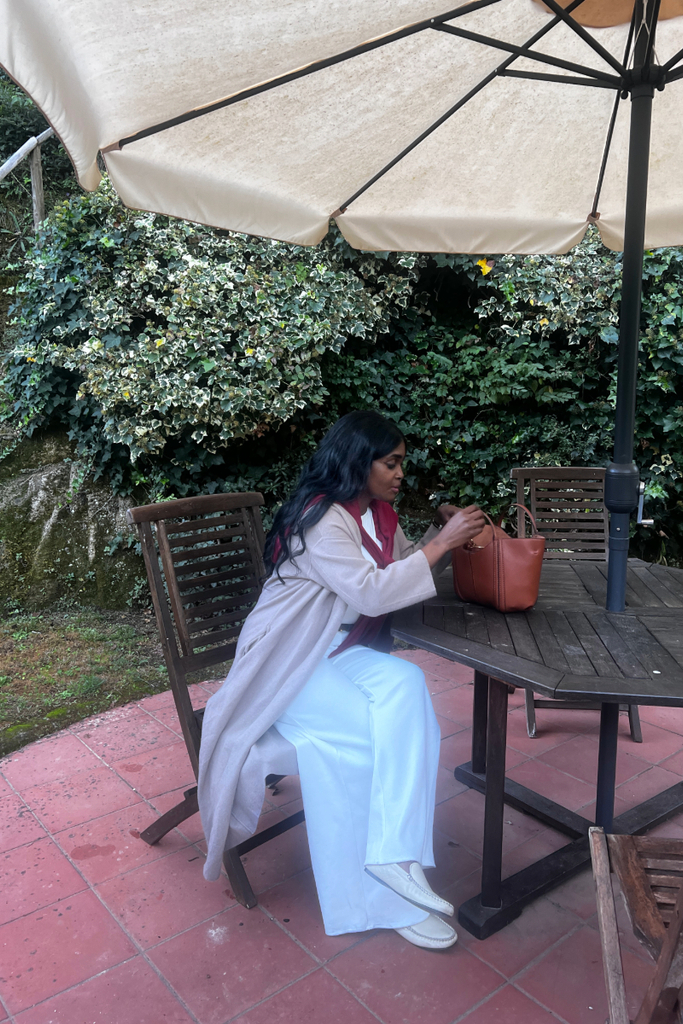
I’ve never quite understood why white trousers are expected to disappear from our wardrobes once summer ends. I’ve always enjoyed wearing lighter colours, and if anything, I find white more interesting in autumn, when the addition of warmer knitwear gives it an entirely different personality. Besides, I’ve never been particularly interested in changing my entire colour palette simply because the season has changed.
For a short getaway from Rome to Pitigliano, I reached for my white wide-leg trousers and a matching top, adding a long hazel-brown cardigan from Massimo Dutti. It’s the sort of cardigan I love because it feels almost as substantial as a coat, but without the formality or weight. I draped a burgundy knit around my shoulders and finished with my cream loafers, creating an outfit that felt comfortable and familiar, but still appropriate for an afternoon away.
Being petite, I sometimes hesitate before combining two generously cut pieces, particularly when one is a long cardigan and the other a pair of wide-leg trousers. But I liked how this combination turned out. The white underneath kept the outfit from feeling too heavy, while leaving the cardigan open allowed it to move naturally as I walked. I didn’t feel swallowed by the layers, which is usually my main concern with longer knitwear.
The burgundy knit was probably my favourite part of the outfit. I love how that particular shade looks against brown, and wearing it loosely around my shoulders gave me the option of putting it on if the afternoon became cooler. It was also a nice change from my usual habit of reaching for a scarf whenever an outfit feels as though it needs something extra.
As for the cream loafers, they were an easy choice. I’ve always preferred shoes that can look elegant without demanding too much attention, particularly when I know I’ll be spending a good part of the day walking. They worked with the white trousers and were comfortable enough for exploring Pitigliano, which meant I could enjoy the afternoon without having to think about my feet.
Looking back, I think what I liked most was that I hadn’t dressed for an imaginary version of an autumn holiday. These were clothes I already enjoyed wearing, put together in a way that suited both the weather and how I wanted to feel that day. The combination was relaxed, with just enough colour and texture to make it interesting, and I didn’t spend the afternoon wishing I’d worn something else.
The styling takeaway: White trousers don’t have to be reserved for warmer months. Pair them with substantial knitwear, introduce a richer accent colour and pay attention to how the different lengths sit together, particularly if you’re petite.
4. The Italian Dinner Look: A Little Black Tailoring, a Lot of White
The formula: Black H&M blazer + navy-blue, gold-buttoned Zara top + white wide-leg trousers + slim belt + textured white scarf + pointed-toe shoes
I’ve recently discovered that some of my favourite evening outfits don’t involve anything particularly new or expensive. For Italy, I reached for a black H&M blazer and a navy-blue, gold-buttoned top I’d picked up in Zara’s sale the previous year. Paired with white wide-leg trousers, the combination was surprisingly versatile, taking me from an afternoon out to dinner without needing a complete change of clothes. I rather liked the fact that neither piece had been bought with this trip in mind.
The navy-and-black pairing was also something I enjoyed experimenting with. Against the darker fabrics, the gold buttons became a feature in their own right, giving the top enough personality that I hardly needed any jewellery. I wore the blazer loosely over my shoulders to keep the buttons visible, while a slim belt brought definition to the generous cut of the trousers. A small textured black handbag and pointed-toe shoes finished things off.
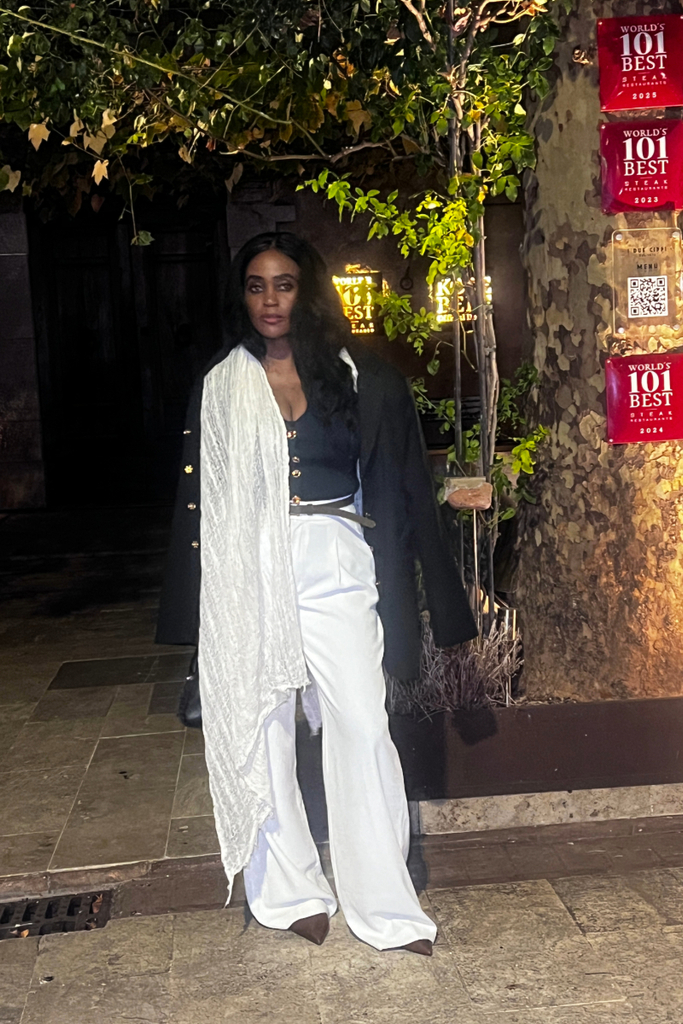
I’ve always had a soft spot for wide-leg trousers, even if, at my height, finding the right length sometimes requires a little negotiation. This white pair has enough volume to make an impression, but I prefer wearing it with something more fitted on top. I also like the contrast between the relaxed movement of the trousers and the sharper construction of the blazer. It’s a combination I find myself returning to because it feels dressed up without being overly formal.
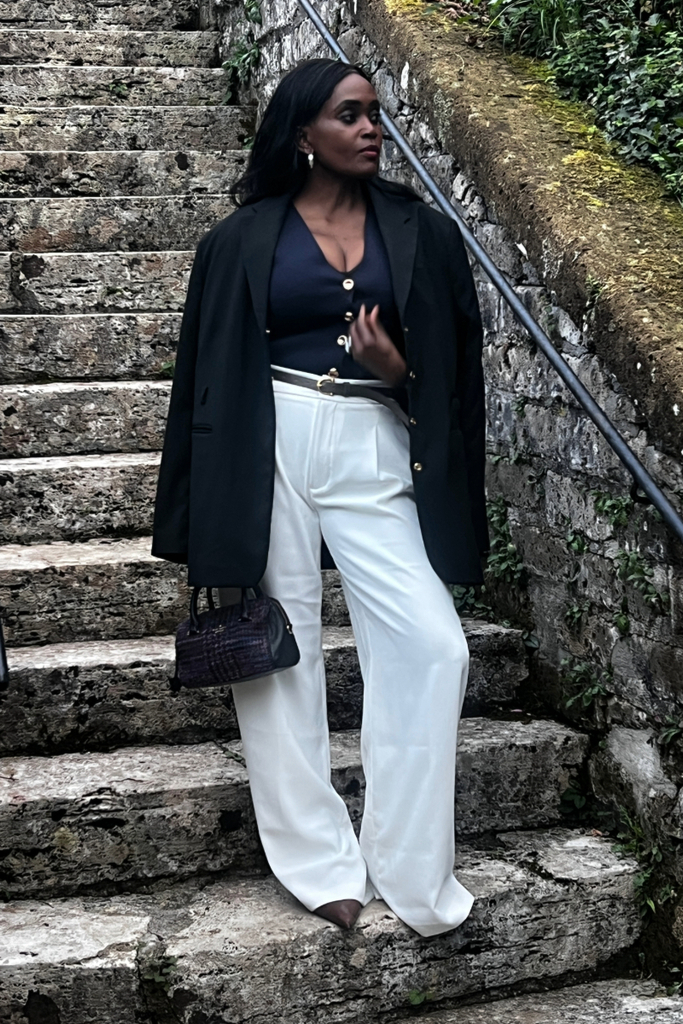
For the evening, I introduced a long, textured white scarf, wearing it loosely over one shoulder. I loved the effect. Against the dark blazer, the scarf became almost as noticeable as the trousers themselves, adding softness to an otherwise tailored outfit. It’s not necessarily the first accessory that comes to mind when dressing for dinner, but sometimes the pieces you wouldn’t ordinarily put together turn out to be the most interesting.
Then there’s the question of footwear, which I’ve learnt to approach with a little more realism when travelling. As much as I love a beautiful pair of heels, walking several streets to a restaurant in an Italian city isn’t always the occasion to test their endurance, or mine. I’d much rather make the journey in comfortable loafers and change into my heels somewhere closer to the restaurant. It might not be the most glamorous part of getting dressed, but there’s little pleasure in arriving for dinner with aching feet before you’ve even ordered a glass of wine.
What pleased me most about this outfit, however, was how naturally the pieces came together. The H&M blazer and Zara top were already familiar parts of my wardrobe, while the white trousers and scarf gave me enough room to play with the overall look. I hadn’t packed them with a particular restaurant or evening in mind, yet they worked beautifully together when the occasion presented itself. It’s a useful reminder that getting more out of your wardrobe sometimes has less to do with what you buy and more to do with the combinations you haven’t tried yet.
The styling takeaway: A good blazer earns its place in a suitcase when it can do more than dress up an evening outfit. The most successful combinations often come down to proportion: a fitted top against generous trousers, a little gold detailing in place of excessive jewellery, or a textured scarf that changes the character of familiar separates. The pleasure is in making small adjustments that have a noticeable effect, rather than feeling obliged to pack something different for every occasion.
5. The Travel-Day Look: Relaxed Denim, Soft Knitwear and White Trainers
The formula: Blue wide-leg jeans + fitted white top + long beige cardigan + white trainers + brown leather accessories + dark sunglasses
Travel days have a habit of becoming more than simply getting from one place to another, particularly when driving through Italy. A morning spent packing the car might lead to an unexpected lunch stop, a detour through a small town or an afternoon exploring somewhere we’d originally intended to drive straight past. It makes sense, then, to dress for the possibility of the day rather than just the journey itself.
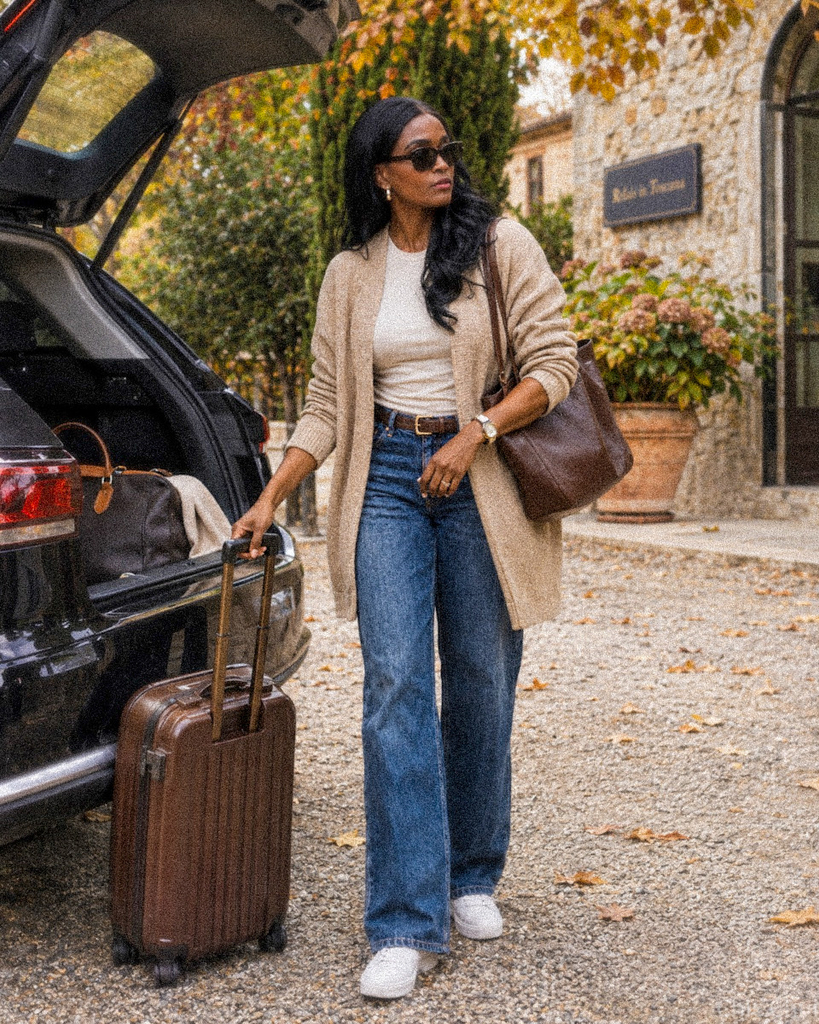
Note: AI-generated editorial image based on an outfit I wore during the trip. The setting is illustrative.
For this look, I paired blue wide-leg jeans with a fitted white top, layered beneath a long beige knitted cardigan. White trainers kept things casual, while a brown leather belt, oversized shoulder bag and dark rectangular sunglasses completed the outfit. Nothing particularly elaborate, but enough to feel dressed for whatever the day might bring.
The cardigan was the piece that made the difference. Its length gave the otherwise ordinary combination of jeans and a white top a more relaxed silhouette, while the soft knit offered a pleasing contrast to the denim. The brown leather accessories introduced a little warmth, particularly against the lighter colours.
There’s also something appealing about an outfit that doesn’t look as though it’s trying to make an impression. Not every day on holiday calls for careful accessorising or an especially polished look, and I think there’s room for that kind of simplicity in a travel wardrobe. The sunglasses were perhaps the only indulgence, although I would argue that they’re practically compulsory on an Italian road trip.
More importantly, these were the sort of separates that could easily be worn again in different combinations throughout the holiday. The cardigan could accompany tailored trousers, while the jeans would look equally at home with a blazer.
The styling takeaway: Casual dressing becomes more interesting when you pay attention to the relationship between shapes and textures. A fitted top balances relaxed denim and long knitwear, while brown leather accessories lend warmth to an otherwise understated palette. The result feels appropriate for the journey without being defined by it.
Read More: This Is the Most Flattering Trench Coat I’ve Ever Owned (I Bought a Second One Immediately).
Building Your Autumn Italy Wardrobe: Three Styling Principles
Looking back at these five combinations, what interests me most is how little they rely on owning anything particularly unusual. White jeans, a black blazer, a trench coat, favourite knitwear and comfortable shoes are hardly groundbreaking wardrobe pieces. Yet the possibilities become much more interesting when you begin considering how the shapes, colours and textures interact.
Three styling principles proved especially useful when thinking about what to pack for Italy in autumn.
Let Accessories Change the Outfit
A structured handbag, sculptural belt or carefully chosen scarf can alter the impression of familiar clothes without requiring a completely different combination.
This is particularly useful when travelling with a limited selection of separates. A simple top and jeans can take on a more polished appearance with a distinctive belt and handbag, while different footwear can shift the look from casual sightseeing to dinner.
Pay Attention to the Proportions Underneath
Long cardigans, relaxed tailoring and trench coats all introduce additional fabric, which makes the proportions of the layers underneath worth considering.
A tucked-in top can define the waist beneath a long knit, while cropped trousers draw attention to the shoes and create a visible break at the ankle. These are relatively small adjustments, but they can make a considerable difference to the way an outfit sits on the body.
Choose Footwear for the Itinerary, Not an Idealised Version of It
I’ve previously written about the three-shoe rule for travel, but this particular trip saw me pack five pairs: coffee-brown Zara loafers, Zara kitten-heel slingbacks, burgundy M&S ballet flats, cream Massimo Dutti loafers (and white trainers I bought at the end.)
Not exactly the strict minimalist approach I’d discussed before, especially when one of those pairs occasionally travelled around in my handbag waiting for its photographic debut.
Yet our itinerary moved between city walks, vineyard visits, countryside stays and dinners, all with different practical considerations. Some shoes were better suited to long walks, while others offered a particular finish to an outfit.
I don’t think a successful travel wardrobe should be measured exclusively by how few items fit into a suitcase. The more useful question is whether those items serve a genuine purpose and work well with the rest of what you’ve packed.
Someone visiting Rome for a long weekend may find two or three pairs entirely sufficient. A longer journey across different regions and occasions might call for greater flexibility.
A More Personal Approach to Italian Autumn Style
Ten days in Italy reminded me that some of the most enjoyable moments of getting dressed happen when you stop thinking quite so much about getting everything right. There were outfits I’d planned in advance, others that came together on the day, and the occasional decision to carry an extra pair of shoes simply because I wanted a particular photograph.
I suppose that’s what I enjoy most about fashion. There’s room to be practical without becoming predictable, to appreciate beautiful clothes without constantly shopping for them, and occasionally to make a slightly ridiculous decision in the name of a good outfit.
And if there’s one thing I’ll take into my next trip, it’s that a wardrobe should leave room for a little spontaneity. After all, the point of travelling isn’t to spend the entire holiday thinking about what you’re wearing, but to enjoy yourself while you’re wearing it.
For more practical advice on regional temperatures, layering, footwear and packing, read my companion guide, The Anti-Haul Capsule: What to Wear in Italy in Autumn, Using What You Already Own.
Follow my Instagram page ChicChui

